The open banking API market has crossed $29.78 billion in 2026, growing at a 14.95% CAGR — and the provider roster has expanded accordingly. Choosing the wrong open banking API provider costs integration time, compliance exposure, and transaction revenue. This comparison maps the leading platforms by regional strength, service type, and regulatory posture so decision-makers can shortlist faster.
What Open Banking API Providers Actually Do
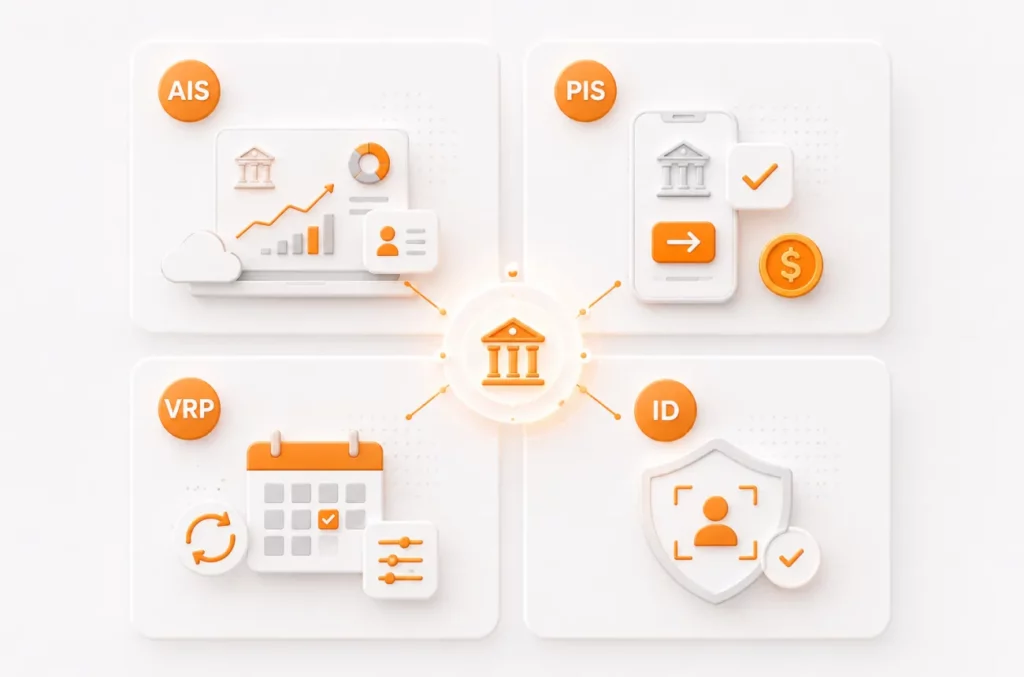
An open banking platform acts as a licensed bridge between banks and third-party applications. Providers handle technical connectivity, consent flows, and regulatory authorisation that would otherwise require months of direct bank negotiation. Four core service categories define what any integration can deliver:
- Account Information Services (AIS) — read-only access to balances, transaction history, and account metadata for credit decisioning, PFM, and verification
- Payment Initiation Services (PIS) — direct bank-to-bank payment execution without card networks, enabling pay by bank at checkout
- Variable Recurring Payments (VRP) — programmable recurring debits on open banking rails, central to the PSD3 roadmap
- Identity and Account Verification — real-time KYC using live bank data rather than document uploads
Matching service type to a specific use case — not simply choosing the largest provider — determines whether an open banking API integration generates ROI or becomes technical debt.
Leading Open Banking API Providers Worth Knowing
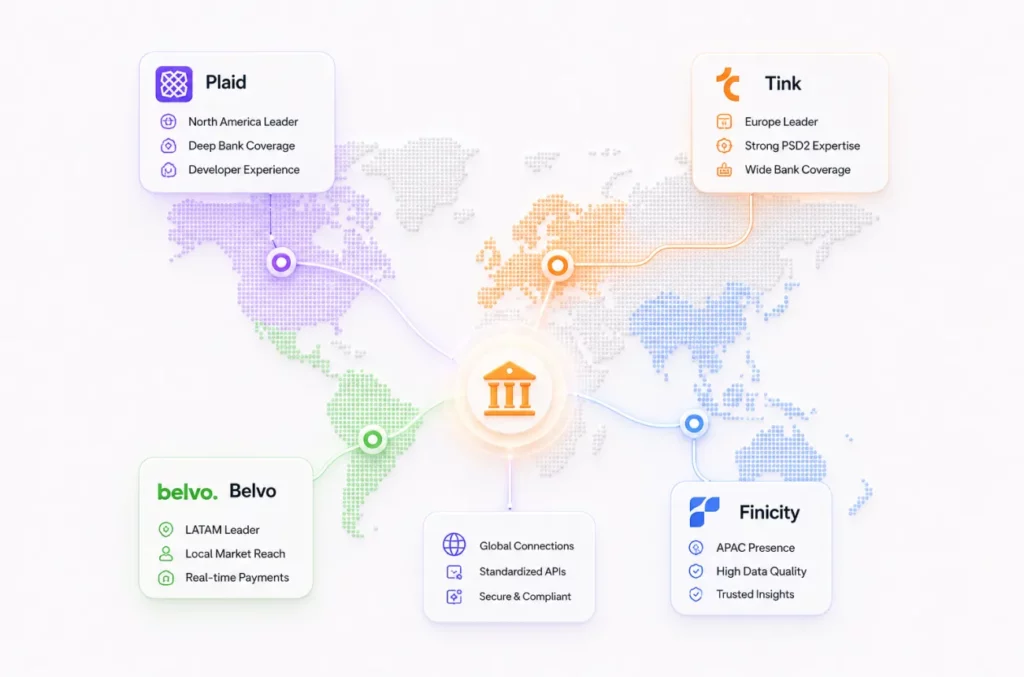
The 2026 provider landscape divides by geography and core competency. Regional depth consistently outperforms broad-but-shallow coverage when transaction success rates matter. The table below maps the most established platforms against their primary strength and optimal deployment context:
| Provider | Core Strength | Best For |
| Plaid | US bank coverage (11,500+ institutions) | Lending, PFM, account verification in North America |
| Tink (Visa) | European AIS + PIS, 3,400+ banks | Data enrichment, payment initiation across EU |
| TrueLayer | UK/EU instant payments, 3,000+ banks | E-commerce, travel, iGaming checkout |
| Yapily | DACH + UK depth, API-first architecture | PSPs and fintechs building embedded products |
| Salt Edge | Global compliance layer, 46 countries | FSPs needing delegated PSD2 licensing |
| Volt | Real-time A2A, 5,000+ UK/EU banks | High-velocity retail and marketplace disbursements |
| Belvo | LATAM connectivity | Mexico, Brazil, Colombia-focused fintech products |
Regulatory frameworks determine where each provider holds full licensing authority. European platforms align to PSD2 and the emerging PSD3 standard; US providers follow CFPB Section 1033 and the FDX standard; Australian operations fall under the Consumer Data Right (CDR). Selecting a provider already licensed in the target jurisdiction eliminates that compliance burden from the internal team entirely.
Key Criteria for Selecting an API Provider
Bank count figures dominate provider marketing, yet four operational factors determine whether an integration performs in production rather than only in demos:
- Bank coverage quality — verified connection depth in target markets matters more than headline institution counts; sandbox parity against the banks handling the majority of target-market volume is the real test
- Unified API architecture — a single endpoint covering AIS, PIS, and identity verification reduces integration overhead and eliminates the cost of managing multiple vendor relationships
- Compliance delegation — providers extending their own PSD2 or PISP licence to clients accelerate time-to-market by months and reduce ongoing regulatory monitoring requirements
- Pricing model transparency — per-connection, per-call, and monthly-active-user structures carry different unit economics at scale; total cost of ownership at projected volume should drive shortlisting
Developer experience — sandbox realism, OAuth 2.0 implementation quality, and SDK completeness — functions as a leading indicator of production stability and post-launch defect rates.
How TODA Pay Completes Your Open Banking Stack
Open banking API providers excel at bank data access and account-to-account payment initiation. Card-based disbursements to employees, contractors, or marketplace sellers require a dedicated rail. TODA Pay delivers that capability through its Card Payout solution, connecting the data and A2A strengths of open banking infrastructure with card network reach for outbound payment workflows. Pairing an open banking platform with TODA Pay closes the disbursement gap without adding a third integration vendor.
Frequently Asked Questions
What is an open banking API provider?
An open banking API provider is a licensed intermediary connecting businesses to bank infrastructure through standardised, consent-based interfaces. These platforms handle regulatory authorisation, technical connectivity, and data formatting across AIS, PIS, and identity verification services.
What is the difference between AIS and PIS in open banking?
Account Information Services (AIS) deliver read-only access to transaction history, balances, and account data for analytics and verification purposes. Payment Initiation Services (PIS) execute direct bank-to-bank transfers on behalf of users, bypassing card networks entirely.
Which open banking providers comply with PSD2 and PSD3?
European providers including Tink, TrueLayer, Yapily, Salt Edge, and Volt operate under full PSD2 authorisation across EU and UK markets. PSD3 introduces enhanced SCA requirements and formalises VRP standards, which leading providers are already incorporating into their technical roadmaps.
How do open banking APIs protect sensitive financial data?
Providers apply OAuth 2.0 authorisation flows, TLS encryption in transit, and Strong Customer Authentication (SCA) at every consent and payment step. Financial data passes directly between the bank and the requesting application without persisting on the provider’s servers.
Do open banking APIs support cross-border payments and card payout?
Leading open banking API providers support cross-border A2A transfers within SEPA and through local rails such as Brazil’s Pix and Australia’s PayTo. Card-based outbound disbursements require a dedicated solution — a capability TODA Pay delivers as a direct complement to open banking infrastructure.