Developers and founders mix these two names up constantly, and the confusion makes sense on the surface. Both sit deep inside modern fintech stacks, both ship excellent APIs, and both show up in the same technical conversations. Yet Plaid vs Stripe isn’t really a fair fight, because the two solve different problems entirely.
Plaid connects apps to a user’s bank account to read financial data, while Stripe processes payments to actually move money. Understanding that single distinction saves most teams from picking the wrong tool, or worse, assuming they need to choose only one.
Core Differences: Data Aggregation vs Payment Gateway
Plaid specializes in financial data aggregation. It securely links an application to a user’s bank account, verifies balances, and confirms account ownership through bank authentication, all without moving a single dollar. Stripe works as a payment gateway instead, processing cards, digital wallets, and bank transfers to complete an actual transaction.
These platforms rarely compete head-to-head, since one reads data and the other moves money. Teams building a lending app often need Plaid’s verification layer. Teams building a checkout flow usually need Stripe’s processing engine. Many products, in practice, need both to work side by side.
Global Payment Methods and Multi-Currency Support
Businesses accepting money globally face very different toolkits depending on which platform they lean on. Stripe brings a massive card and digital wallet ecosystem spanning dozens of countries. Plaid brings deep bank-level access focused on direct debit and open banking rails, particularly across the US, UK, and EU.
| Feature | Plaid Capabilities | Stripe Capabilities |
| Supported methods | Bank transfers, ACH, direct debit via open banking | Credit cards, debit cards, digital wallets, local payment methods |
| Global reach | Strongest in US, UK, and EU banking networks | Broad reach across 40+ countries and multiple currencies |
| Primary use case | Verifying accounts and reading financial data | Processing and settling actual transactions |
Neither platform covers every region equally well. However, teams needing enterprise-grade credit card processing at global scale typically reach for Stripe first, then add Plaid where direct bank verification adds value. For teams building that verification layer independently, a dedicated TODA Pay’s Open Banking platform handles the bank-side connections without requiring a full Plaid integration.
Subscription Management and Recurring Billing
Stripe built subscription management directly into its core product, handling proration, dunning, and invoicing without extra tooling. That makes it a strong default for SaaS billing, especially for companies running usage-based or tiered pricing.
Plaid takes a different route. It supports recurring charges mainly through variable recurring payments and balance checks before each ACH transfer runs. For straightforward subscription products, Stripe’s built-in billing engine usually wins on convenience alone.
Plaid vs Stripe: Using Both APIs Together
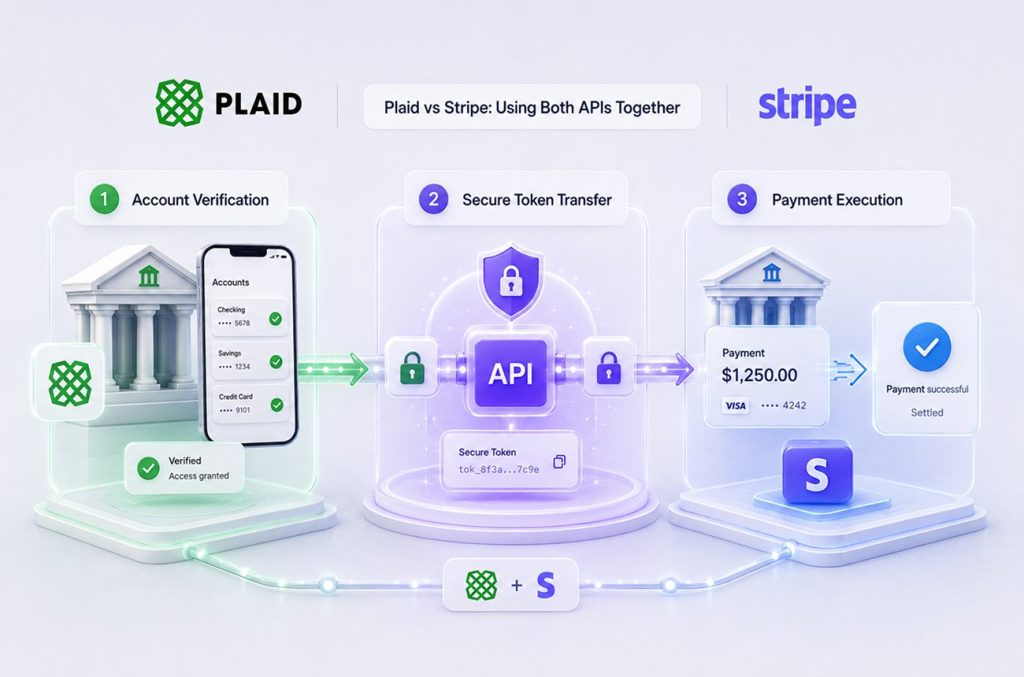
Here’s the part most comparisons skip entirely: plenty of companies run Plaid and Stripe in the same checkout flow, not as competitors but as a pair. The pattern shows up constantly in lending apps, marketplaces, and any business moving money via ACH transfers.
- Plaid Auth verifies the user’s bank account and confirms ownership in seconds
- The app passes that verified account token to Stripe instead of asking for manual details
- Stripe initiates the ACH transfer or payment using the pre-verified account information
This combination cuts fraud risk and abandonment at once, since users skip typing routing numbers by hand and businesses skip the guesswork of unverified accounts.
Pricing Structures and Transaction Fees
Cost models diverge sharply once you compare the two side by side. Stripe charges a flat-rate percentage plus a small fixed fee per transaction, consistent across most card payments. Plaid runs on volume-based, pay-as-you-go pricing, shifting to custom enterprise rates once usage climbs.
| Cost Type | Plaid Model | Stripe Model |
| Base pricing | Pay-as-you-go per API call, custom enterprise tiers at scale | Flat percentage plus fixed fee per transaction |
| Currency conversion | Not applicable — Plaid doesn’t move money directly | Additional markup applied on cross-currency transactions |
| Dispute costs | Not applicable | Chargeback fees apply per disputed transaction |
Hidden costs tend to surface in different places for each platform. Stripe’s currency conversion and chargeback fees can add up fast for global sellers, while Plaid’s costs scale mostly with API call volume rather than transaction value.
Marketplace Solutions: Stripe Connect vs Plaid
Multi-vendor platforms need more than simple processing — they need to split funds across multiple sellers and manage payouts at scale. Stripe Connect handles that job directly, and most marketplace payments infrastructure gets built on top of it.
Stripe Connect gives marketplace builders a few core advantages out of the box:
- Automatic fund splitting between platform and individual sellers
- Global payout support across dozens of currencies and countries
- Built-in tax reporting for connected accounts
- Flexible onboarding flows for sellers of any size
Plaid still plays a role here, though a narrower one. It verifies seller bank accounts during onboarding, confirming ownership before Stripe Connect routes any payout their way. Marketplaces that need reliable TODA Pay’s credit card processing alongside that payout logic often add it as a separate, dedicated layer rather than relying on one processor for everything.
PCI Compliance and Fraud Prevention Compared
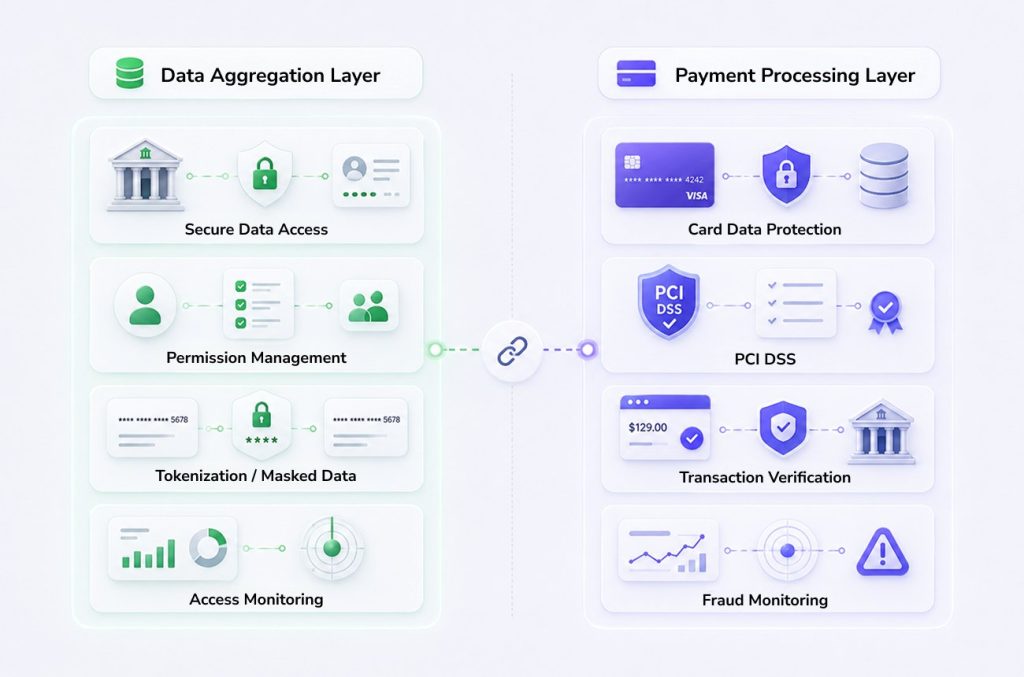
Security frameworks differ because the platforms handle different types of risk. Stripe maintains PCI compliance and SOC 2 certification, tokenizing card data and running machine learning fraud detection on every transaction. Plaid maintains SOC 2 compliance too, but its risk centers on data access rather than payment fraud.
Stripe ultimately assumes more direct liability for fraudulent transactions and chargebacks, since it’s the platform actually moving the money. Plaid’s exposure sits further upstream, tied to account access rather than settled funds.
- Tokenization that replaces sensitive card and bank details with secure references
- Continuous monitoring that flags unusual transaction patterns in real time
- Certified compliance standards that satisfy enterprise security requirements
Both platforms invest heavily in these protections, but neither eliminates fraud risk completely. Businesses still need their own fraud rules layered on top.
Developer Experience and Merchant Dashboards
Implementation speed matters as much as raw capability for most engineering teams. Stripe ships extensive documentation, SDKs for nearly every language, and out-of-the-box e-commerce platform plugins for Shopify, WooCommerce, and similar tools. Plaid’s documentation stays technical and developer-first, built for teams already comfortable with financial data structures.
Merchant dashboard design reflects the same split. Stripe’s dashboard reads more like a business tool, while Plaid’s reads more like a developer console built for engineers, not finance teams.
Choosing the Right Payment Processor Setup
Plaid and Stripe solve different halves of the same problem, and most growing businesses eventually need both. Plaid confirms who owns an account and reduces fraud before money moves. Stripe handles the actual movement, from checkout to payout, across cards and bank transfers alike.
The real decision isn’t Plaid or Stripe — it’s how much of each a specific product actually needs, and where a third specialized provider might handle one side better than either platform does natively.
Plaid vs Stripe: Frequently Asked Questions
Is Plaid a direct competitor to Stripe?
Not really. Plaid aggregates financial data, while Stripe processes payments — most teams end up using both for different jobs.
Can I use Stripe without Plaid for ACH transfers?
Yes. Stripe supports ACH transfers independently, though Plaid’s verification step can reduce failed or fraudulent transfers.
Which platform is better for SaaS billing?
Stripe, in most cases. Its built-in subscription management handles proration, invoicing, and dunning without extra tooling.
Do both APIs support global multi-currency payments?
Stripe supports multi-currency payments broadly. Plaid focuses on bank connectivity, mainly across the US, UK, and EU networks.
How do chargebacks work on Plaid vs Stripe?
Chargebacks apply to Stripe, since it processes the actual payment. Plaid doesn’t handle chargebacks, as it never moves funds directly.