Stripe vs Fiserv represents one of the most searched comparisons in B2B payments — yet most businesses find the answer the same way: by choosing the wrong provider first. Stripe targets online-first companies with developer APIs. Fiserv serves banks and enterprise institutions with custom infrastructure. Understanding where each platform draws its boundaries saves months of costly integration work and prevents fee surprises at scale.
Stripe vs Fiserv: Core Differences Explained
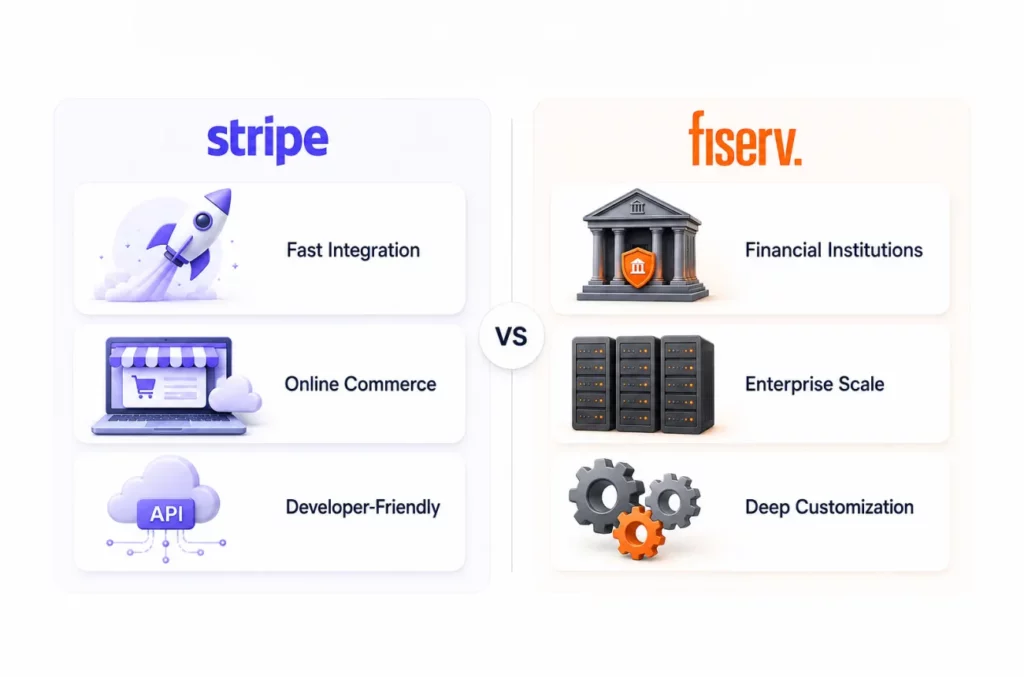
These two platforms share the payment processing category but serve fundamentally different markets. Stripe launched in 2010 as a developer-first API company; Fiserv has operated since 1984 as a financial infrastructure provider for banks and large institutions. That 26-year gap in origin shapes every product decision each company makes today.
| Feature | Stripe | Fiserv |
| Primary market | SaaS & online businesses | Financial institutions & enterprise |
| Countries | 46 | 100+ |
| Pricing model | Flat-rate, published | Custom, negotiated |
| Settlement speed | 2–4 business days | 1–2 business days |
| Instant payout | Yes (1% fee) | Yes (enterprise accounts) |
| Recurring payments | Native (Stripe Billing) | Via Payment API |
| Payment links | Yes | No |
The table above captures the structural divide. Stripe optimises for speed of deployment; Fiserv optimises for depth of institutional integration.
How Stripe Handles Payment Processing
Stripe operates as both a payment gateway and a payment processor, giving online merchants a single integration point. Its Optimised Checkout Suite includes a hosted checkout page, embedded UI components, and Stripe Link — a one-click checkout experience for returning customers. Support spans 100+ payment methods across 46 countries, covering cards, digital wallets (Apple Pay, Google Pay), ACH transfers, SEPA, BNPL options (Klarna, Afterpay), and stablecoins.
Stripe Transaction Fees and Costs
Stripe publishes its pricing transparently, but the fee structure layers quickly for merchants processing international or high-dispute volume. Key rate points to evaluate:
- Standard US transactions: 2.9% + $0.30 per successful card charge
- UK standard cards: 1.5% + 20p; premium UK cards 1.9% + 20p
- International cards (non-EEA): 3.25% + 20p, plus 2% currency conversion
- Dispute fees: £20 per chargeback received; Smart Dispute costs 30% of the disputed amount
Flat-rate pricing gives growing businesses predictable per-transaction costs. Cross-border volume above certain thresholds, however, warrants a direct rate negotiation with Stripe’s enterprise team.
How Fiserv Processes Payments at Scale
Fiserv functions simultaneously as a merchant acquirer and a payment processor — handling card authorisation, settlement, and the underlying data movement between banks. Its product suite for commercial clients includes the hosted Checkout page, a Payment API for custom integration, and Carat — an enterprise orchestration layer designed for businesses processing payments across multiple channels and geographies.
Core characteristics that distinguish Fiserv’s infrastructure:
- Operates in 100+ countries with support for 50+ global clearings on a single platform
- Processes ISO 20022-standard financial messages, critical for cross-border institutional payments
- Covers major card schemes (Visa, Mastercard, Amex) plus regional methods including Alipay, Bancontact, iDEAL
- Delivers enterprise-grade settlement typically within 1–2 business days for qualifying accounts
Fiserv’s acquirer-processor dual role reduces the number of intermediaries in the payment chain — a structural advantage for large-volume merchants negotiating settlement terms directly.
Stripe vs Fiserv Pricing: What Merchants Pay
The pricing models diverge at a foundational level. Stripe publishes a complete rate card; Fiserv requires direct contact for a quote. Each approach carries specific trade-offs for different business sizes.
Critical pricing differences to factor into provider evaluation:
- Stripe instant payouts carry a 1% surcharge on top of standard transaction fees
- Fiserv custom pricing factors in industry type, transaction volume, risk profile, and payment method mix
- Stripe Smart Dispute charges 30% of the disputed amount — a material cost for merchants with elevated chargeback ratios
- Fiserv enterprise contracts may deliver lower effective rates for merchants processing millions monthly, reflecting volume-based negotiation
Stripe’s flat-rate model benefits early-stage businesses that value cost predictability. Fiserv’s negotiated structure rewards established merchants whose volume justifies a dedicated commercial relationship.
Fiserv vs Stripe: Integration and Developer Tools
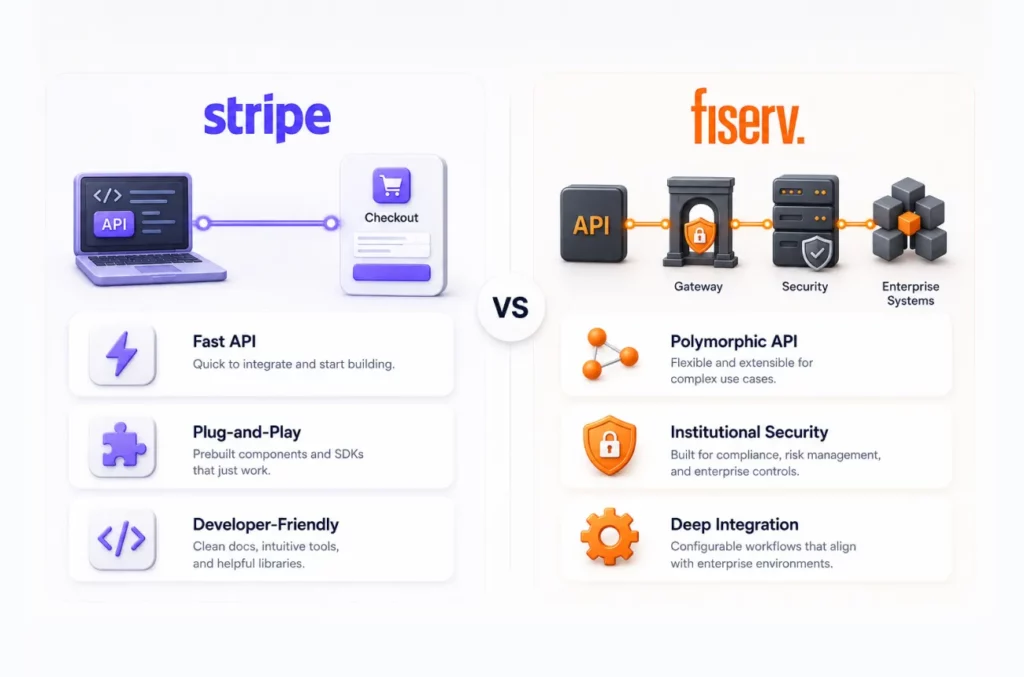
Both platforms expose REST APIs with sandbox environments and webhook support, but the developer experience diverges significantly in scope and target user. Stripe’s API documentation consistently ranks as the industry benchmark for developer usability.
Key technical differentiators between the two platforms:
- Stripe offers Instant Sandbox — a feature Fiserv does not provide — enabling immediate testing without additional provisioning steps
- Fiserv’s Polymorphic Payment API accepts multiple request types on a single endpoint, covering primary transactions, voids, refunds, and pre-authorisation completions
- Stripe Connect handles marketplace payouts to sub-merchants, a native feature critical for platform businesses
- Fiserv Developer Studio provides API documentation, code recipes, and a dedicated portal — built for enterprise integration teams rather than independent developers
Tokenization and PCI DSS compliance infrastructure exist in both platforms. Stripe’s 3D Secure fingerprinting runs automatically at checkout; Fiserv’s 3DS implementation requires explicit configuration within the Payment API workflow.
Which Business Type Fits Each Provider
The choice between Stripe and Fiserv maps cleanly to business profile rather than to feature preference. Misalignment between provider model and business type drives the majority of mid-contract migrations.
Clear matching criteria for each platform:
- Choose Stripe for SaaS, e-commerce, or marketplace businesses that need fast onboarding, native subscription billing, and a transparent fee structure without contract negotiations
- Choose Stripe if the development team will build custom checkout flows via API and requires extensive third-party integration coverage across payment methods and accounting tools
- Choose Fiserv if the organisation operates as a financial institution, processes enterprise-level transaction volumes, or requires a direct acquirer relationship with negotiated settlement terms
- Choose Fiserv if payment infrastructure must integrate with existing bank-grade systems, AML compliance layers, or ISO 20022 message flows
Neither platform holds a universal advantage. The fit depends on transaction channel, volume, technical resources, and the internal capacity to manage or outsource payment infrastructure complexity.
A Direct Card Payment Solution for Growing Businesses
Businesses that outgrow the developer-first simplicity of Stripe — or find Fiserv’s enterprise model inaccessible — benefit from a purpose-built alternative. TODA Pay delivers a direct Card Payment infrastructure designed for commercial-scale merchants who need transparent pricing, fast settlement, and a single integration point without the operational overhead of enterprise contract cycles.
Stripe vs Fiserv: Common Questions Answered
What is the main difference between Stripe and Fiserv?
Stripe targets SaaS companies and online businesses with developer-first APIs and transparent flat-rate pricing. Fiserv serves financial institutions and large enterprises through custom infrastructure and negotiated long-term contracts.
Is Stripe cheaper than Fiserv for online payments?
Stripe publishes flat rates starting at 2.9% + $0.30 per transaction, but additional fees for instant payouts, disputes, and FX conversion raise the effective cost at scale. Fiserv’s custom payment processing pricing may deliver lower per-transaction rates for high-volume enterprise merchants with negotiating leverage.
Does Fiserv support recurring payments and subscriptions?
Fiserv supports scheduled and recurring payments through its Payment API, primarily for enterprise clients with custom integration requirements. Stripe offers native recurring billing through Stripe Billing, a tool purpose-built for SaaS and subscription-first business models.
Which provider offers faster payment settlement?
Fiserv typically settles enterprise payments within 1–2 business days, while Stripe’s standard settlement runs 2–4 business days. Both payment providers offer instant or near-real-time payout options for eligible accounts, with Stripe charging a 1% surcharge for that service.
Can a growing business use both Stripe and Fiserv together?
Yes — businesses running both providers gain redundancy, broader regional coverage, and access to a wider range of payment methods across markets. The operational overhead of managing two integrations, however, warrants careful evaluation against the specific business need before committing to a dual-provider architecture.