Lemon Squeezy vs Stripe is not a simple comparison of price tags. These two platforms operate on fundamentally different legal and financial architectures — and that distinction shapes every decision a SaaS founder makes, from tax filing obligations to customer ownership. Understanding the structural difference between a merchant of record and a payment processor is the starting point for choosing correctly.
Merchant of Record vs Payment Processor Explained
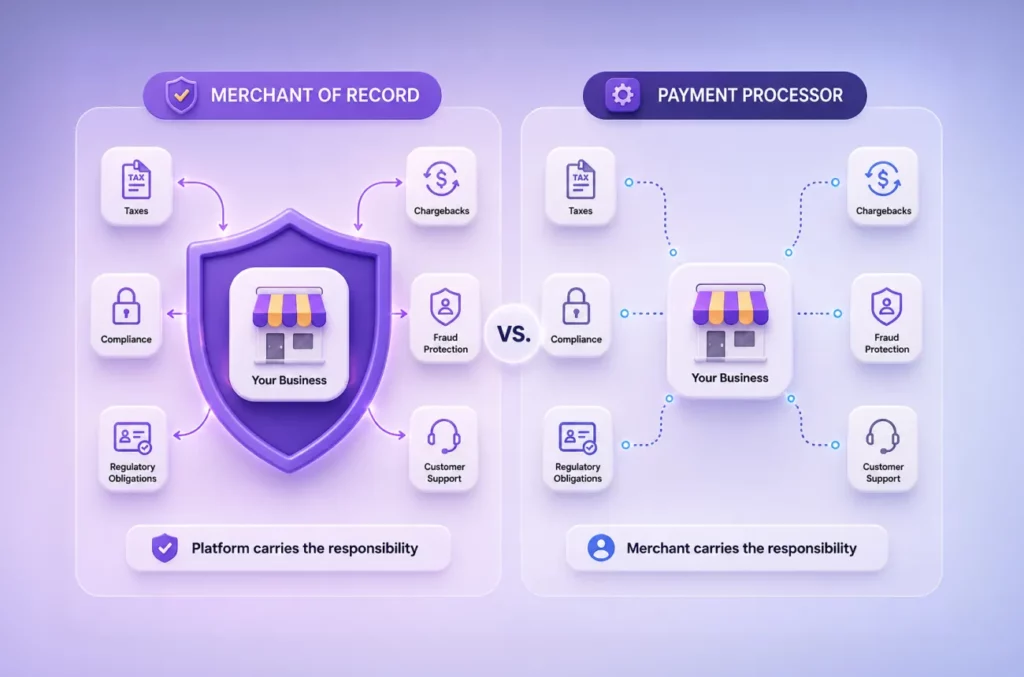
The core distinction defines who bears legal responsibility for each transaction. With Lemon Squeezy, the platform legally sells the product to the customer and assumes full liability for taxes, compliance, and chargebacks. With Stripe, the merchant retains that role — Stripe moves the money, but the business remains the seller of record.
| Criteria | Lemon Squeezy (MoR) | Stripe (Payment Processor) |
| Legal seller | Lemon Squeezy | The merchant |
| Tax liability | Platform handles VAT, GST, Sales Tax | Merchant calculates and remits |
| Chargeback risk | Platform absorbs | Merchant absorbs |
| Brand on statement | “Lemon Squeezy” | Merchant’s brand name |
| Compliance burden | Zero for merchant | Merchant’s responsibility |
This architectural split — not the feature list — determines which platform aligns with a given business model.
Lemon Squeezy vs Stripe Fee Comparison
Both platforms publish a base rate. Neither base rate reflects what a global SaaS business actually pays. Stripe’s published rate of 2.9% + $0.30 per transaction is the floor, not the ceiling.
The components that push Stripe’s effective rate higher for international SaaS include:
- Stripe Billing add-on: +0.5% per transaction for subscription management
- Stripe Tax: +0.5% per transaction for automated tax calculation
- Cross-border and FX fees: +1–1.5% for international card transactions
- Third-party tax software (Avalara/TaxJar): $200–500/month for full global compliance
Lemon Squeezy charges a flat 5% + $0.50 per transaction. That rate covers merchant of record services, fraud protection, tax handling, and global compliance — with no add-ons. For founders selling globally at low to mid ticket prices, the all-inclusive structure eliminates unpredictable cost stacking.
How Lemon Squeezy Handles Global Tax Compliance
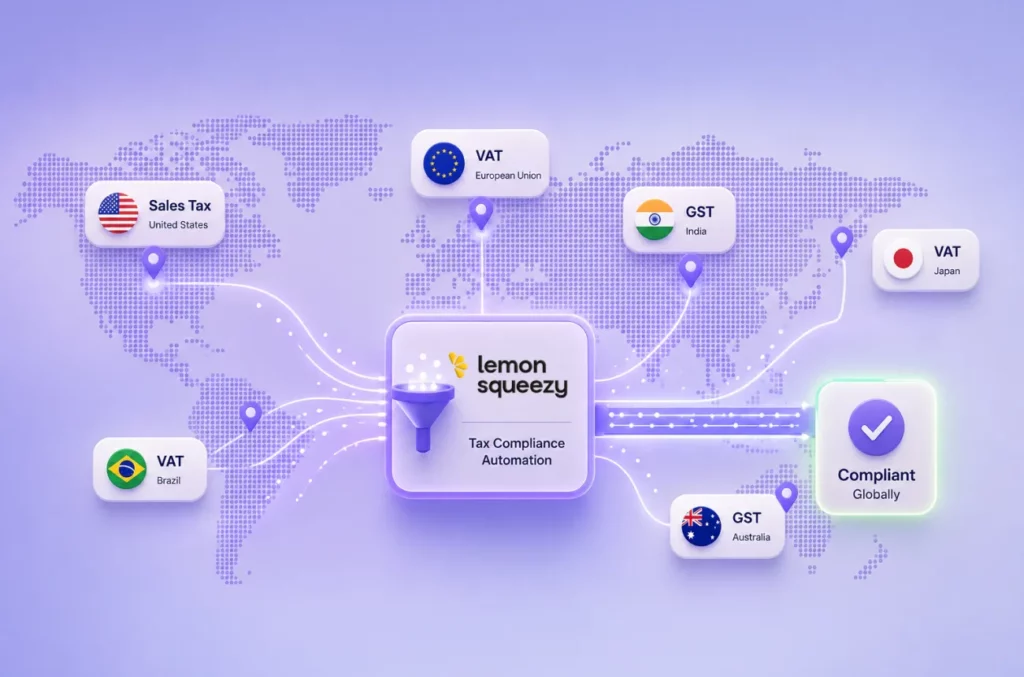
Global tax compliance ranks as the single largest operational burden for SaaS businesses selling across jurisdictions. A $20/month subscriber in Germany triggers EU VAT obligations; a customer in Australia creates GST requirements; sales in New York carry state-level sales tax liability.
As a merchant of record, Lemon Squeezy absorbs that entire obligation:
- Calculates and collects VAT across all EU member states
- Remits GST in Australia, Canada, India, and other GST jurisdictions
- Manages US sales tax across applicable states
- Delivers a single monthly payout — no tax filings, no multi-jurisdiction registrations
Stripe Tax addresses the same problem from a different angle: it automates tax calculation at 0.5% per transaction and integrates with third-party remittance tools. For most early-stage startups, micro-business thresholds in the EU reduce the immediate compliance burden — making Stripe Tax a workable solution before revenue reaches registration triggers.
Subscription Billing and Payment Methods Compared
SaaS subscription billing requirements vary significantly between early-stage products and scaled platforms. Both tools support recurring revenue, but with different levels of sophistication.
The key differences across billing architecture and payment method coverage:
- Stripe Billing supports metered/usage-based billing, proration, multi-plan add-ons, and complex trial logic — purpose-built for subscription complexity at scale
- Lemon Squeezy provides hosted checkout with built-in license key delivery, digital file distribution, and affiliate management — optimised for speed of launch
- Payment methods: Stripe supports 100+ global and local methods including bank transfers and offline terminals; Lemon Squeezy covers major cards, PayPal, Apple Pay, Google Pay, Alipay, WeChat Pay, and ACH
- Customer portal: both platforms offer self-serve subscription management for end customers
Stripe delivers billing depth; Lemon Squeezy delivers launch velocity. The right choice depends on where a business currently sits on that curve.
Which Platform Fits Your Business Model
Business stage and geographic distribution determine the correct architecture, not personal preference. Lemon Squeezy removes the operational overhead that makes global monetisation complex — at the cost of a higher per-transaction rate and reduced data ownership.
Lemon Squeezy fits when:
- The business is a solo founder or small team without a dedicated finance function
- Products are low-to-mid ticket B2C digital goods ($10–$100) with global buyer distribution
- Speed to revenue matters more than optimising per-transaction margin
- The US represents the primary or dominant revenue market
The all-inclusive MoR model trades margin for operational simplicity — a rational exchange for early-stage products where compliance complexity would otherwise consume founder time.
When Stripe Becomes the Stronger Choice
Stripe’s value compounds as transaction volume increases and billing requirements grow more complex. The payment processor model returns full legal ownership of the customer relationship to the merchant — including brand visibility on every bank statement.
Stripe fits when:
- The product is B2B SaaS or a high-ticket offering ($100+) where per-transaction fee differences compound at scale
- Custom checkout design and branded payment experience are product requirements
- The business requires Stripe Connect for marketplace or split-payment flows
- Long-term financial infrastructure demands full data portability and API control
At 1,000 transactions on a $299 product, the fee gap between Stripe (~$9/transaction) and Lemon Squeezy (~$15.50/transaction) reaches $6,500 — before tax software costs are factored in.
Expand Payment Options Beyond Stripe and Lemon Squeezy
Both Stripe and Lemon Squeezy concentrate on card-based and digital wallet transactions. As payment behaviour diversifies across markets, limiting checkout to those methods leaves conversion on the table. Buyers in high-growth markets increasingly prefer local payment rails, bank-direct transfers, and regional wallets that neither platform covers natively.
Alternative Payment Methods extend checkout coverage beyond cards and wallets — connecting SaaS and digital product businesses to the payment preferences that drive conversion in specific geographies. TODA Pay APM solutions integrate alongside existing Stripe or Lemon Squeezy setups, adding payment method depth without replacing the billing infrastructure already in place.
Frequently Asked Questions
Is Lemon Squeezy better than Stripe for SaaS?
Lemon Squeezy fits solo founders selling low-ticket digital products globally without managing tax compliance. Stripe serves B2B SaaS teams that require custom billing, full data ownership, and lower fees at scale.
What are the real fees of Stripe vs Lemon Squeezy?
Stripe’s base rate of 2.9% + $0.30 rises to 4–5% globally once billing, tax, and FX fees are added. Lemon Squeezy charges a flat 5% + $0.50 that covers tax handling, fraud protection, and MoR services.
Does Lemon Squeezy handle VAT and sales tax automatically?
As a merchant of record, Lemon Squeezy calculates, collects, and remits VAT, GST, and sales tax across all active jurisdictions. Merchants receive a single payout with no tax filings or compliance obligations.
Can I migrate from Lemon Squeezy to Stripe?
Payment data exports are possible through Stripe tooling since Lemon Squeezy runs on Stripe infrastructure. Existing subscribers must re-enter card details at a new checkout, so most teams migrate new customers while retaining legacy subscribers.
Does Stripe own Lemon Squeezy?
Stripe acquired Lemon Squeezy in July 2024 to expand its merchant of record capabilities. Both platforms continue operating independently, serving distinct business models and customer segments.